




More than 35 hours a week, around forty weeks a year spent sitting at work, that's a lot! For office workers , the conclusion is clear: a sedentary lifestyle is an integral part of daily life .
Sitting for long periods every day leads to health problems . The impact is physical, mental, and cognitive . While this issue concerns employees, employers must also take responsibility for ensuring and improving working conditions, the well-being of their staff, and the overall performance of the company.
As such, active furniture presents an interesting solution for creating a healthier, more comfortable and dynamic work environment .
What is active furniture?
The term “active furniture” encompasses all office equipment that encourages movement , even during sedentary tasks.
Designed to combat the harmful effects of prolonged sitting , active furniture promotes daily physical activity . It also enhances comfort, concentration, and overall well-being at work.
Active office furniture comes in various forms , such as sit-stand desks, ball chairs, ergonomic stools, pedal exercisers or office bikes.
Differences from traditional office furniture
Unlike traditional office furniture, which is rigid and fixes the body in a single posture, active furniture encourages constant movement, changes of position, and a more dynamic posture .
Active furniture is designed to be more ergonomic and adaptable to users. It is not only designed to be aesthetically pleasing, but also to meet the requirements of use and the body shape of workers.
5 good reasons to adopt active furniture
Active office furniture offers numerous benefits for users and employers by helping to improve physical and mental health and well-being, as well as employee concentration, motivation, productivity and dynamism for better results.
Encourage movement without interrupting work
The primary benefit of active furniture is to combat sedentary behavior at work by giving employees the opportunity to stay in motion while continuing to work .
Some furniture encourages alternating positions (sitting-standing), others micro-movements and a dynamic posture.
Without leaving your desk, your body and blood circulation remain active.
Improve posture and prevent musculoskeletal pain
By incorporating movement and reducing sedentary behavior, active office furniture improves posture and prevents musculoskeletal disorders (MSDs) .

Indeed, it contributes to:
- adopting a better posture at work
- to engage the deep muscles (particularly the lumbar and dorsal muscles),
- and to avoid static positions .
You therefore suffer less from back and neck pain, muscle tension and joint stiffness.
Keeping your body active through exercise also offers other benefits for your physical health , reducing the risk of cardiovascular disease and metabolic disorders (weight gain, digestive problems, type 2 diabetes, etc.).
For employers, preserving the physical health of employees is an excellent way to limit accidents and work stoppages .
Boost concentration and productivity
Active office furniture promotes blood flow to the brain, boosting your cognitive and mental abilities . This maximizes your concentration and focus at work, resulting in less mental fog at the end of the day. By encouraging a dynamic posture, active office furniture also stimulates mental agility and creativity .

For employers, this offers the advantage of having more alert, energetic, and productive employees who make fewer mistakes and resolve problems more quickly. Active furniture creates a dynamic and engaging work environment . Staff are therefore motivated, and the atmosphere is friendly and conducive to interaction and collaboration.
Reduce fatigue associated with prolonged sitting
The gentle but continuous movement helps to avoid discomfort and energy dips . Body and mind are protected.
Indeed, active furniture improves blood circulation and oxygen supply to tissues. As a result, you feel less tired and more alert throughout the day .
Promoting overall well-being
Finally, active office furniture contributes to your overall well-being (mental and physical) , as it reduces tension and boosts your energy, thus limiting work-related stress and anxiety .
You feel more inclined to get up, stretch, and breathe. This improved quality of life at work, where sedentary behavior is no longer tolerated, promotes the release of endorphins , the "feel-good" hormones.
In short, active furniture improves mood and supports your mental health at work .

For employers, preserving employee well-being is an excellent way to limit sick leave and job abandonment .
The different types of active furniture and their benefits
The sit-stand desk

The sit-stand desk is one of the best-known types of active furniture. It uses a mechanical or electronic mechanism to adjust the height of its surface according to your height and the position in which you wish to work.
By encouraging alternating positions throughout the day , this type of desk reduces the risk of musculoskeletal disorders and fatigue associated with prolonged sitting , as it promotes blood circulation, muscle activity, and energy levels. The risk of circulatory problems, including the formation of blood clots that can lead to a heart attack or pulmonary embolism, is also reduced.
English research, which led to the creation of the Smart Work and Life program , highlights that 66% of workers who sit one hour less per day at work feel more productive and 87% more energetic .
Sit-stand desks offer the opportunity to stretch your body without interrupting your work and to adopt a better posture, thus limiting the need for breaks during the day .
Furthermore, standing burns more calories than sitting, even when remaining perfectly still. In fact, you burn between 100 and 200 calories per hour standing, compared to 60 to 130 sitting. Your metabolism is stimulated, and the risk of obesity and diabetes decreases.
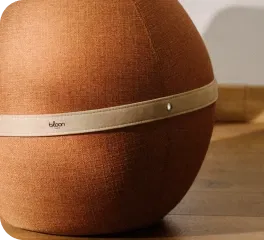
The balloon seat

The exercise ball or Swiss ball engages the deep core and back muscles to compensate for instability and maintain balance. This muscle strengthening in the back and abdominals reduces musculoskeletal disorders (MSDs ).
You adopt a very straight posture without even realizing it.
The ergonomic ball unconsciously encourages a dynamic working posture and movement, offering numerous benefits for your health and productivity .
Discover here all the benefits of the Swissball in the office and the Bloon Active Seating .
The ergonomic or dynamic stool

Like the exercise ball seat, the ergonomic stool promotes a dynamic sitting position in order to maintain an upright posture and prevent back pain .
Thanks to its unstable or tilting base, this mobile seat works your deep postural muscles by encouraging constant micro-movements. Your abdominal muscles are strengthened, which reduces the risk of tension in the back, neck, and shoulders associated with a sedentary lifestyle .
In addition, the dynamic stool improves blood circulation and mental alertness. You are less tired, more focused, and more productive .
This active piece of furniture is flexible and versatile. It is suitable for various uses, such as traditional workspaces, workshops, kitchens, and is also suitable for both adults and children.
The office treadmill

The office treadmill is placed in front of a sit-stand desk so that you can walk without interrupting your work tasks .
This allows you to have active standing work sessions , combating sedentary lifestyles and their consequences on health .
Walking while working helps you burn calories and adopt a more ergonomic posture .
The benefits of treadmills are numerous, both physical and mental. Indeed, while they stimulate blood circulation and reduce pain and musculoskeletal disorders , they also have a positive impact on your mental health and motivation . By encouraging light to moderate physical activity throughout the day, they release endorphins, improving mood and reducing anxiety .
Another advantage is that treadmills offer great flexibility of use. They allow you to choose the pace that suits your needs and activity level (slow, moderate, or fast). Compact, discreet, and quiet, the most modern models integrate easily into any work environment.
The desktop pedal assembly
Silent, compact and inexpensive, the desktop pedal exerciser is an interesting solution for staying active during your workday .
Simply slide it under your regular desk and pedal gently or more quickly during your work sessions. While it's typically used with the legs, you can also use it with your arms to strengthen your upper body.
Cycling while working a few hours a week helps to stay in shape , burn calories and build muscle mass .
You benefit from improved blood circulation and brain oxygenation , and you feel more focused and less tired .
Desktop exercise bikes are often equipped with LCD screens that allow you to track your speed, distance traveled, and calories burned. You can also adjust the resistance levels.
To rediscover the true feeling of cycling, you can also opt for a desk bike . Less compact and more expensive, it is placed opposite a traditional desk.
The active footrest
Also consider active footrests . Oscillating or with an unstable surface, they encourage constant rocking movements of the ankles and legs, which promotes blood circulation and prevents leg numbness .
You can usually adjust its height and tilt to suit your body shape.
Conclusion
Active furniture is equally suited to traditional workspaces and innovative open-plan offices. It's a simple and effective solution for combating sedentary behavior, improving posture, and boosting your professional performance .
Incorporating more movement into your daily routine at the office has a positive impact on your physical and mental health , without compromising your productivity. Active furniture promotes a more dynamic, sustainable, and adaptable way of working, better suited to today's challenges.