



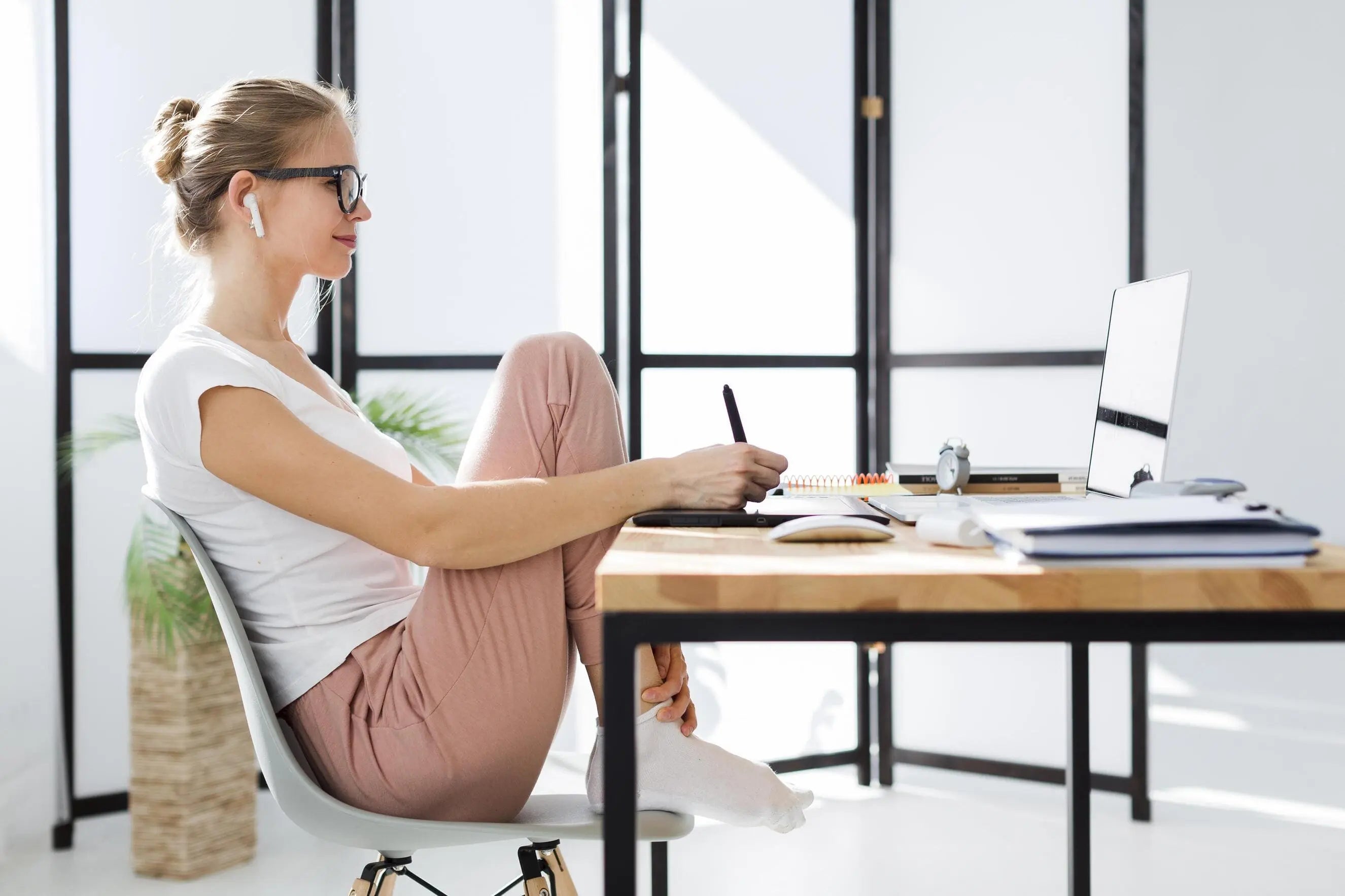
Whether you work in an office, a coworking space, or remotely, you likely spend many hours sitting each day . On average, French adults spend 12 hours sitting on workdays and 9 hours on their days off.
Prolonged sitting poses risks to your health, even if you exercise outside of work hours. In fact, according to 60% of companies, it is the third most common risk factor in the workplace .
Fortunately, there are simple and effective solutions to stay active while working in order to combat the harmful effects of a sedentary lifestyle .
The risks associated with prolonged sitting
Without seeming like it, sitting too often and for too long has serious consequences for your physical and mental health , but also for your cognitive abilities .
Here are the main risks associated with prolonged sitting:
Cardiovascular risks

First, sitting for most of the day increases the risk of death from cardiovascular disease by 34% and all-cause mortality by 16% , according to a 13-year study published in JAMA Network Open that followed 481,688 adults. The French National Institute of Health and Medical Research (Inserm) also found that spending more than 6 hours a day sitting increases the risk of cardiovascular disease by 20% compared to those who sit less than 3 hours a day.
Regularly exercising after work would not make a difference for those who spend 10 hours or more sitting per day.
A sedentary lifestyle tires the heart, slows metabolism and blood flow , which is responsible for circulatory problems, hypertension, heart attack and stroke .
Musculoskeletal disorders

Remaining static in a seated position for several consecutive hours each day can lead to muscle pain in the lower back, neck, and buttocks, as well as tendinitis or myofascial syndrome of the pelvic floor , all classified as musculoskeletal disorders . The problem is exacerbated by stress or non-ergonomic working conditions.
According to the French National Agency for the Improvement of Working Conditions (ANACT), nearly 60% of French workers suffer from back problems due to poor posture or a sedentary lifestyle. Across the continent, millions of European workers are affected by musculoskeletal disorders (MSDs), which represent the leading occupational health problem within the European Union.
Constant pressure on the spine can cause serious long-term damage such as herniated discs .
Discover our articles to find out if your back pain is serious .
Circulatory problems
Sitting and a sedentary lifestyle impede blood circulation, potentially increasing the risk of blood clots . Venous thrombosis and varicose veins are common circulatory problems in people who sit for extended periods .
Metabolic disorders
Lack of movement is detrimental to your metabolism, which is conducive to metabolic disorders, such as fat accumulation or insulin resistance .

When you sit for too long, you expend little energy and burn few calories. Your metabolism slows down, as does your digestion, promoting fat storage , particularly around the abdomen, leading to weight gain, and potentially even overweight or obesity . Scientific studies prove that sitting at a desk can increase waist circumference by several centimeters.
Recurrent static postures also promote insulin resistance and disrupt blood glucose regulation, potentially leading to type 2 diabetes . Furthermore, there is a correlation between mortality in diabetic adults and time spent sitting .
Impact on mental health

In addition to its impact on your physical health, prolonged sitting can have detrimental effects on your mental health, notably due to a decrease in endorphin production and an increase in cortisol. This can lead to a greater risk of chronic stress, anxiety, or depressive symptoms .
Tips to avoid sitting for too long
To limit the risks to your health and well-being, we have compiled several tips to avoid sitting for too long at the office or in your daily life .
Incorporate regular active breaks
The first thing to do to break up a prolonged static position is to incorporate frequent active breaks into your routine.
Every 30 to 60 minutes , get up for 5 to 10 minutes to walk, stretch, do some movements or exercises like squats. These active minutes help to boost blood circulation and relieve accumulated muscle tension .
The key is to never exceed 2 hours of continuous sitting .
Take every opportunity to get up and move around in your office, at home or outdoors such as during coffee and lunch breaks.
In addition to stretching routines, consider strengthening exercises to improve your muscle endurance.
Taking active breaks is a right for employees. For employers, it's important to motivate employees to be more active in order to boost their concentration and motivation . For example, you can offer short, dynamic activities such as garden maintenance, composting, or recycling. You can also create a space for active breaks with some sports equipment (yoga mats, resistance bands, rowing machines, ping-pong table, etc.).
Opt for active meetings
Just like your breaks, make your meetings active .

Organize your meetings standing or walking to encourage movement and avoid prolonged immobility . In addition to combating the harmful effects of a sedentary lifestyle on your health , this helps improve concentration and creativity .
Active meetings also have the advantage of being more efficient and shorter than traditional meetings. They engage your dynamism and energy, and strengthen commitment and participation.
Working in motion
When you are working , it is possible to do it while moving .
Take every opportunity to get up from your desk .
For example, walk into your colleague's office instead of sending them an email. Make your phone calls standing up or while walking around your desk. Place the printer or photocopier in another room to minimize walking. Always take the stairs instead of the elevator.

Finally, consider active furniture to combat a sedentary lifestyle while you work. Various pieces of furniture allow you to stay active without disrupting your work, such as sit-stand desks, pedal exercisers, treadmills, or stationary bikes. Among ergonomic active seating options , you can choose a dynamic stool or a Bloon Active Seat .
Preventing pain and problems arising from prolonged sitting
For most office workers, prolonged sitting is unfortunately not always possible. It is therefore important to take steps to reduce the problems that result from it.
Improve your posture to reduce musculoskeletal disorders
To reduce musculoskeletal disorders , try to adopt the correct posture at work and in everyday life .
If you are working on a screen , sit comfortably with your back straight and your shoulders relaxed and aligned with your hips. Both feet should be flat on the floor and your knees should be at a 90° angle. Your screen should be at eye level to avoid tilting your head forward and to protect your spine.

Maintaining good sitting posture helps prevent stress, tension on muscles and joints , which limits the risk of injury and back pain .
Create an ergonomic workspace to support your physical, mental, and cognitive health at work.
Setting up an ergonomic workstation has positive effects on your physical, mental, and cognitive health .

Here are the basic ergonomic equipment items to prioritize :
- An ergonomic seat: an ergonomic seat properly supports the lumbar region and the natural curve of the back to improve your posture and avoid muscle tension associated with prolonged sitting.
- A support for your screens: position your screens at eye level to prevent neck and spinal strain.
- An adjustable footrest : this accessory reduces discomfort in the legs and lower back. In addition, it facilitates blood circulation.
- An ergonomic mouse and/or keyboard: place them close together to avoid straining your arms and joint tension.
Do regular physical exercises to strengthen your back and stretch.
Doing exercises during and after your workday helps to limit cardiovascular risks .
The WHO recommends 150 minutes of moderate activity per week for adults. Even short daily activity sessions, such as 6 minutes of vigorous activity or 30 minutes of moderate activity, are beneficial in slowing the harmful effects of a sedentary lifestyle .
At work, complement your active breaks with a daily exercise routine . Find our various articles on the subject:
- to exercise discreetly at the office
- best stretches at the office
- exercises with a ball in the office .
Muscle strengthening exercises are particularly beneficial for preventing chronic pain and stabilizing the spine . You can do plank exercises or glute bridges.
Stretching at the office reduces muscle tension, improves blood circulation and productivity.
In general, prioritize walking or cycling. Outside of office hours, regular physical activity is essential.

Practice relaxation to reduce stress and mental impact
Our final tip for preventing the harmful effects of prolonged sitting is to practice relaxation . Yoga exercises, deep breathing, or mindfulness meditation can help soothe tension and reduce physical and mental stress .
Dedicate a few minutes a day to these practices to improve your overall well-being .
Conclusion
Sitting all day at work poses a major public health challenge . However, it is not inevitable.
You can inject movement into your work routine by using active furniture, incorporating breaks, and holding active meetings. Every movement counts, even the smallest ones.
Other tips can help limit the harmful effects of a sedentary lifestyle, such as an ergonomic workstation, regular exercise, better posture and relaxation techniques.
FAQ: All about prolonged sitting
What constitutes prolonged sitting?
Prolonged sitting is defined as being sedentary for 2 consecutive hours or more .
It involves 3 elements: a seated posture, reduced calorie consumption and a static load.
What is considered prolonged sitting?
Prolonged sitting is considered to occur when it lasts more than 2 consecutive hours or more than 6 hours in total per day , several days of the week.
Beyond that, health risks may arise.
What kind of pain can you experience from sitting for too long?
When you sit for too long, it is common to suffer from lower back, neck, abdominal, buttock or pelvic pain .
They result from prolonged compression on an area of the body and from muscle fatigue.
What are the consequences of sitting too much?
Sitting for too long has consequences of varying severity for your physical and mental health : increased risk of cardiovascular disease, musculoskeletal disorders, type 2 diabetes, overweight, stress, anxiety, depression…
What are the risks of lying down all day?
The risks of lying down all day are practically the same as for sitting , i.e., sedentary behavior.
In addition, bedsores may appear.
How long is it healthy to remain seated?
For your health, it is recommended not to sit for more than 1 to 2 hours at a time . It is recommended that you take short breaks every 30 to 60 minutes to get up and do some exercises. In total, do not exceed 6 hours of sitting per day . Ideally, you should spend less than 50% of your working time sitting.