



At the office, sedentary behavior due to prolonged sitting is a real scourge for your health and well-being.
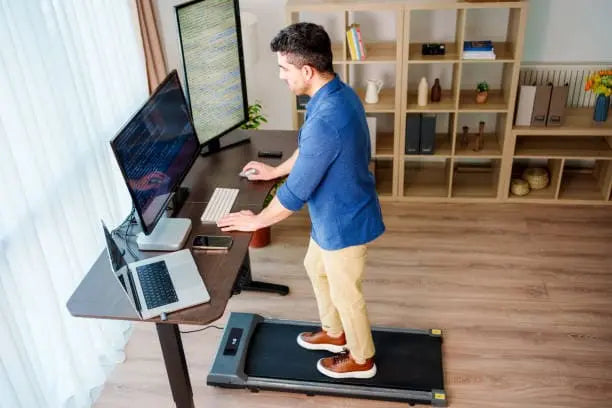
To address this, ergonomic solutions , such as the exercise ball chair and the sit-stand desk , are becoming increasingly common. But have you considered the treadmill ? Growing in popularity, it allows you to work standing up while walking at a slow pace , thus combating the negative effects of sedentary behavior at work.
The dangers of a sedentary lifestyle in the office
A sedentary lifestyle at work presents several risks to your physical and mental health , as well as to your productivity . Moreover, according to the WHO , sedentary behavior is responsible for 3.2 to 5 million deaths per year.
Back pain and musculoskeletal disorders

Spending many hours sitting at your workstation each day promotes prolonged poor posture, tension, stiffness, and lower back pain .
Today, musculoskeletal disorders (MSDs) , which cause chronic pain and fatigue, are the main cause of sick leave.
Risk of cardiovascular disease
Inactivity reduces the stimulation of your heart and blood circulation, which promotes cholesterol and the buildup of fats on the arteries. This increases the risk of cardiovascular diseases such as hypertension or atherosclerosis.
Increased risk of diabetes

Lack of physical activity also tends to slow down your metabolism . Gradually, your body develops insulin resistance due to a disruption in blood glucose regulation.
In the long term, type 2 diabetes can develop, a major health problem in developed countries.
Blood circulation problems
A sedentary lifestyle is also the cause of venous stasis , leading to circulatory disorders .
You may therefore suffer from heavy legs, swelling, edema and, in the most serious cases, be at risk of phlebitis.
Negative impact on mental health
Beyond its impact on your physical health, a sedentary lifestyle affects your mental well-being . It increases stress, anxiety, and mental fatigue , potentially leading to depression.
Indeed, inactivity promotes the secretion of cortisol, the stress hormone, and inhibits that of endorphins, the feel-good hormones.
The benefits of working while walking
Incorporating walking into your workday , even at low intensity, helps to combat sedentary lifestyles and their devastating effects .
Improving posture and preventing pain
Walking while working helps improve posture and prevent pain by reducing pressure on the back and neck caused by prolonged screen work.
This gentle and regular activity activates your muscles, helps to release tension and prevent musculoskeletal disorders.
Increased professional performance

Working while walking stimulates blood circulation and brain oxygenation for increased productivity and motivation .
Your vigilance and concentration increase, limiting the risk of errors and optimizing your efficiency.
Slow walking can also awaken creativity . A study from Stanford University shows that walking on a treadmill promotes inspiration and reflection.
Stress reduction and increased energy
Regular walking at the office promotes the release of endorphins . These feel-good hormones reduce stress and anxiety , as well as the perception of pain.
Your energy and motivation increase tenfold, your mood and mental health improve.
Weight management aid

Finally, walking at a slow pace during your working hours activates your metabolism and contributes to maintaining a healthy weight in addition to a balanced diet.
You burn more calories than by sitting all day, which helps you fight against weight gain often associated with a sedentary lifestyle.
Read our full article on weight loss at work .
Treadmills in the office: an effective solution to combat sedentary lifestyles?

Unlike a workout that requires planning, a treadmill allows you to combine work and physical activity without constraints . You stay active while fulfilling your professional tasks.
It therefore represents an innovative solution for combating sedentary lifestyles and improving quality of life at work (QWL) . This alternative to sit-stand desks and exercise ball chairs promotes changes in posture and adds gentle, regular physical activity to your workday.
Advantages of the treadmill at work
Treadmills or walking desks offer several benefits to workers:
- reduction of time spent sitting,
- improvement of physical fitness,
- stress reduction,
- brain stimulation,
- Pain relief and relief from musculoskeletal disorders (MSDs),
- ease of installation in any workspace (depending on the model).
Limitations of the treadmill in the office
However, the use of a treadmill has certain limitations , as it is not suitable for all activities, such as precise drawing or dense writing, nor for all people.
Furthermore, some models can be bulky and insufficiently discreet . Their noise can disrupt concentration.
Finally, they are not compatible with traditional desks . You need a height-adjustable desk, such as a sit-stand desk.
How to properly use a treadmill in the office?
Choosing a treadmill suitable for the office
Online, you will find many models of treadmills ranging from a hundred euros to a thousand euros.
Opt for a compact, quiet model that is especially compatible with your sit-stand desk .
It should be easily adjustable to suit the height of your desk.
The ideal speed for working while walking
The generally recommended walking speed is between 1 and 4 km/h to ensure the walk remains comfortable enough to work efficiently on a keyboard and screen. Find a pace that suits you.
We suggest you start by :
- Start with short sessions of 10 to 15 minutes per day, gradually increasing the duration.
- At a speed between 1.5 and 2 km/h to get your body used to it and avoid fatigue.
Once you're used to it, walk for about 30 to 60 minutes a day, then alternate with a dynamic sitting or standing position.
The posture to adopt
Adjust your rug and desk to the correct height to maintain an ergonomic posture:
- Maintaining an upright posture helps prevent muscle pain and tension.
- 90° elbows,
- relaxed shoulders,
- Screen at eye level to avoid neck pain and eye strain.
Also remember to vary your positions regularly (walking, sitting, standing), wear appropriate shoes , stay hydrated and take regular breaks to stretch.
FAQ: Working while walking
Is it better to work sitting down or standing up?
There is no single best position. However, prolonged sitting becomes harmful. Ideally, you should alternate between sitting and standing, and perhaps even incorporate walking .
Does walking while working help with weight loss?
Walking while working helps prevent weight gain at work by continuously burning a moderate amount of calories.
Combined with a healthy lifestyle, including a healthy and balanced diet, walking to the office can contribute to weight management .
Is it legal to work standing up or walking?
Yes, there are no regulations prohibiting working while standing or walking . On the contrary, legislation encourages employers to provide ergonomic and safe working conditions for their employees.
Is it really possible to work on a treadmill?
Yes, you can work on a treadmill by choosing a quiet model that suits your office. Remember to adjust the speed to ensure you can complete your routine tasks that require less thought (emails, calls, video meetings, etc.).
Not all tasks can be performed on a treadmill. For activities requiring intense manual and mental concentration, we recommend sitting or standing.
Can I use a treadmill with any type of desk?
Treadmills require you to remain standing, so your desk must be height-adjustable like sit-stand desks. Therefore, they are not compatible with traditional seated desks.
Conclusion
Far from being a mere gadget, the treadmill is establishing itself as a preferred solution to combat the negative consequences of a sedentary lifestyle.
Walking at a low intensity during your workday promotes better physical and mental health, without compromising your productivity.
However, it is important to choose your walking desk carefully, to alternate positions throughout the day, to respect some posture rules and an appropriate speed.