



Increasingly popular, the pregnancy ball or Swiss Ball accompanies pregnant women throughout their pregnancy .
Highly recommended by physiotherapists and midwives, it's not just a fitness accessory. It also offers physical and psychological benefits for expectant mothers .
Discover in this article why this ball has become indispensable and how to use it to its fullest potential.
What is a pregnancy balloon?
Definition
The pregnancy balloon is a large inflatable balloon made of PVC or soft rubber, measuring 55 to 85 cm in diameter .
Aimed at improving the well-being of pregnant women, it gradually became integrated into delivery rooms in the 1990s.
Difference from a classic gym ball
The gym ball was originally created in 1963 by the Italian Aquilino Casino as a children's toy. It is generally referred to as the Swiss ball, as it was used a few years later by the Swiss physiotherapist Klein-Vogelbach for rehabilitation.
Although fundamentally the same accessory, the pregnancy ball has some specific features to adapt it to expectant mothers . Indeed, it is generally more robust and equipped with a reinforced anti-burst system , unlike classic gym balls.
When should I start using a pregnancy ball?

You can start using a ball from the beginning of your pregnancy , adapting the exercises to each trimester.
However, it is from the second trimester onwards that it becomes truly beneficial , as your belly begins to grow, often leading to back and pelvic pain.
How often should a pregnancy balloon be used?
Ideally, you should integrate the pregnancy ball into your daily routine with short sessions .
Start by using it for 10 to 15 minutes a day to allow your body to get used to it, before doing 20 to 30 minute sessions once you have mastered balance and basic exercises.
Regularity is more important than intensity. It's better to use your pregnancy ball for short periods, but regularly, at least 2 to 4 times a week, rather than having long, spaced-out sessions.
The key is not to force it and to stop if you feel any discomfort.
When to use a pregnancy ball?
You can use a pregnancy ball at every stage of motherhood :
- before and during early pregnancy to improve posture
- in mid-pregnancy to relieve pain and improve well-being,
- before and during childbirth preparation,
- postpartum to rebuild your body and perineum muscles.
It can be used at any time of day , while sitting at the office or at home, in the evening for gentle relaxation exercises or before bed for stretches that promote sleep.
Why use a pregnancy balloon?
The pregnancy ball offers numerous benefits during motherhood, both physically and mentally .
During the 3 trimesters of pregnancy: for daily use

Whether it's to sit comfortably, improve your mobility or relieve your ever-changing body, you can use your ball daily throughout your pregnancy .
It allows, in particular, to:
- combating sedentary lifestyles,
- Adopt a straight and balanced posture by straightening your back and engaging your abdominal muscles.
- Do stretches and relaxation exercises to help you unwind and better manage stress.
- work on your breathing,
- Practice muscle strengthening and flexibility exercises to support the increasing weight of your belly and maintain a flexible and mobile pelvis.
- to improve your blood circulation in case of heavy legs,
- relieve lower back and pelvic pain due to the weight of the baby, hormonal changes, weakening of abdominal muscles and change in posture.
When the baby starts to move in utero, sitting on a pregnancy ball can rock and soothe it.
Before and during childbirth: to relieve contractions and dilate the cervix

Towards the end of pregnancy, the ball becomes a valuable ally to prepare for childbirth and relieve the first contractions .
Its use during the 3rd trimester allows you to work on the mobility of your pelvis, to stand upright to orient the baby and to strengthen the muscles of your pelvic floor in preparation for birth.
During childbirth , the birthing ball facilitates and accelerates labor by helping to open the cervix, the descent of the baby, the relief of pain and relaxation between each contraction.
After childbirth: to better recover and strengthen the perineum

Using a birth ball after giving birth is ideal for better recovery, retraining your perineum and strengthening your abdominal muscles through gentle strengthening exercises.
Ball exercises are particularly suitable postpartum, as they respect the fragility of the pelvic floor while reshaping your silhouette and strengthening your abdominal, back and gluteal muscles.
The new mother can also use her pregnancy ball to comfortably rock the baby in a seated position.
How to choose your birth balloon?
Choosing the right pregnancy ball is essential for optimal use and greater comfort.
Many models are now available in stores and online, but not all are suitable for your body shape and physiological changes.
Here are the criteria you should pay attention to when choosing your maternity ball:
What size pregnancy ball should I choose?
Choosing the right size ball is essential to enjoy its benefits and avoid injury. To do this, you must consider your own height and body type:
- If you are less than 1.60 m tall, opt for a ball with a diameter of 55 cm .
- If you are between 1.60 m and 1.75 m tall, the correct size is 65 cm in diameter .
- For women over 1.75 m tall , buy a pregnancy ball with a diameter of 75 cm .
To check that the size is right for you, your knees should form a 90° angle when you are sitting in the center of the ball with your feet flat on the floor. Your hips should be at the same level as your knees or slightly higher. If your knees are higher than your hips, the ball is too small. However, it's better to have a ball that's slightly too big and that you can deflate a little than one that's too small.
Robustness and safety
The sturdiness of your pregnancy ball is a key element of your safety , as you will gain weight throughout your pregnancy. That's why it's essential to choose a ball specifically designed for maternity use, with an anti-burst system , rather than a standard exercise ball.
Your ball must be able to withstand 150 kg or more and meet the various safety standards .
The thickness of the PVC or rubber used in the ball is important for better strength and durability . Ensure it is at least 2 mm thick. Its surface should be grippy and textured to maintain stability and prevent the ball from falling.
Comfort and material
Beyond its resistance, the material must be pleasant to the touch to avoid perspiration and discomfort, knowing that your skin will often be in contact with the ball during exercises.
All-inclusive kit
Ideally, your balloon should be sold with all the necessary accessories for inflation, maintenance and transport.
Removable cover models are easier to care for, which is essential for expectant mothers, who are prone to leaks.
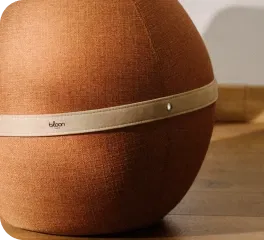
Our Bloon balloon seats are incredibly durable, ultra-comfortable, and safe thanks to a weighted base, a burst-proof guarantee, and a phthalate-free PVC air chamber. They all come with a removable, durable, stain-resistant, and machine-washable fabric cover. Each seat includes an inflation pump and a carrying strap for easy transport.

How to use your pregnancy ball properly?
While choosing the right pregnancy ball is essential, knowing how to use it correctly is equally important. Discover our recommendations to get the most out of your wellness ally at every stage of motherhood.
Recommended positions and movements
First, you need to learn how to position yourself correctly on your pregnancy ball . The basic seated position involves sitting in the center of the ball with your feet shoulder-width apart and your knees aligned with your feet. Keep your back straight and your pelvis slightly forward. Gently place your hands on your hips or the ball for balance. This position helps improve your posture, release tension, and relieve back pain through subtle movements that provide stability.

Gentle back-and-forth rocking helps improve pelvic mobility and blood and lymphatic circulation during pregnancy.
To prepare for childbirth, circular pelvic movements stimulate the cervix and promote dilation. Furthermore, these exercises help the baby to position itself correctly and descend into the pelvis.
Rocking and rotating movements are also indicated to relieve the pain of contractions.
All these movements should of course be performed gently.
Tips for integrating it into your daily life
You don't know how to incorporate the pregnancy ball into your daily routine ?
You can simply use it to sit at your desk or at home while watching television or reading. However, this seat should only be used occasionally and not continuously during pregnancy.
Relax and strengthen your muscles by using it to do some stretching, relaxation and core strengthening exercises .
Safety and precautions
How to properly inflate a pregnancy balloon?
To ensure your safety, stability and comfort, it is important to inflate your pregnancy ball correctly .
Do not inflate your ball when it is cold; it must be at room temperature. The pregnancy ball should not be fully inflated and should remain slightly soft. It is normal for the ball seat to deflate slightly under your weight when you sit down, but it should maintain its round shape and absorb movement. It should never exceed the diameter indicated in the instructions, as this could cause it to burst.
Inflating your pregnancy balloon is child's play. Simply remove the valve cap and insert the pump nozzle, then pump until you reach the desired diameter before replacing the cap.
Precautions and contraindications

Although contraindications to using a birthing ball during pregnancy are rare , we advise you to always consult a healthcare professional before starting, especially in the case of a high-risk pregnancy or unusual pain, such as:
- a threat of premature birth,
- a low-lying placenta,
- unexplained vaginal bleeding,
- frequent contractions before term,
- significant balance problems.
Place your ball in an open area on a non-slip surface . If necessary, you can use it on a yoga mat for added grip and practice near a wall or stable support initially.

Stop your ball exercises immediately if you feel tired, experience unusual pain or dizziness, have abnormal contractions or bleeding.
Systematically avoid sudden movements, but also jumps and bounces, excessive twisting and unstable positions.
Regarding the care of your pregnancy ball, store it in a dry place, away from sunlight and humidity. For example, avoid placing it near a radiator or on heated flooring.
Pregnancy balloon FAQ
When should I start using the pregnancy ball?
You can use your pregnancy ball at any time during pregnancy, even from the first trimester if you wish. However, its benefits begin to become truly noticeable from the second trimester onwards.
What are the benefits of a pregnancy balloon?
It offers numerous benefits during pregnancy, before, during and after childbirth.
It helps to relieve pain, heavy legs and contractions, to adopt a better posture, to prepare for childbirth and to facilitate perineal rehabilitation.
What size balloon should I choose during pregnancy?
The size of your pregnancy ball depends on your height. Pregnant women under 1.65 m should opt for a 55 cm diameter ball, those under 1.75 m for a 65 cm diameter ball, and taller women for a 75 cm diameter ball.
The key is to choose a ball that is comfortable and allows you to adopt the correct position, i.e. to have your knees at 90° when you are sitting and your feet are flat on the floor.
How do you inflate a pregnancy balloon?
To inflate your pregnancy ball, use the pump that is usually provided. Do not inflate it to 100%. You should be able to sit comfortably in the correct position.
Does the balloon help to open the cervix?
Yes, certain movements promote pelvic flexibility, cervical opening, and the descent of the baby.
Although it facilitates labor, the balloon does not trigger labor by itself.
Can a birthing ball be used after childbirth?
Yes, absolutely, you can use it to rehabilitate your perineum and rebuild your muscles postpartum.
Does the pregnancy balloon pose risks for some pregnant women?
Although there are few contraindications, it is always best to seek the advice of a healthcare professional before use.
Does using a ball help relieve sciatic pain?
Yes, the pregnancy ball is particularly recommended for pregnant women with sciatic pain, as it helps improve posture and reduce pressure on the sciatic nerve.
Conclusion
Practical and beneficial at every stage of pregnancy, the pregnancy ball is much more than just an accessory. It supports expectant mothers by relieving pain, promoting relaxation, and preparing the body for childbirth. It is also very useful after birth for pelvic floor rehabilitation, slimming the figure, and improving overall well-being.