




Similar to the Swiss ball, the birthing ball is used before and during pregnancy to promote and support labor. Many midwives and clinics recommend this non-pharmacological tool to facilitate childbirth and improve the comfort of expectant mothers .
Discover, in this article, all the benefits of the birthing ball .
Why use a birthing ball?
The birthing ball is a large-diameter inflatable ball, similar to a yoga ball, specially designed to support the body before, during, and after labor . Its principle is based on three key concepts: mobility, posture, and gravity .
Unlike the traditional lying position, it allows you to remain mobile, vary positions and use gravity to facilitate the baby's descent.
Moving on the ball promotes fetal engagement, cervical dilation, and a reduction in the duration of labor .
The movement becomes a real support to accompany the birth while providing comfort and autonomy .
Benefits of the birthing ball
Beyond its mechanical aspects, the birthing ball offers numerous benefits. It plays a role in managing and relieving pain and improving comfort.
Relieving pain and contractions

Sitting on the ball, making gentle circular or rocking movements helps to relax the muscles of the lower back, the perineum and the hips, areas that are heavily used during labor.
This mobility also helps to stimulate blood and lymphatic circulation , which promotes tissue oxygenation and the elimination of toxins, thus reducing muscle tension, feelings of heaviness and fatigue .
You are better able to manage contractions by diverting attention from the pain and focusing on your breathing in an assisted posture.
Several scientific studies highlight the positive action of the pregnancy ball in relieving contractions , such as this 2022 meta-analysis or this 2023 study on the perception of pain in women pregnant for the first time.
To encourage cervical dilation and the descent of the baby
Sitting on a birthing ball, you benefit from a natural and dynamic posture that helps open the pelvis, release the sacrum and loosen the hips so that the future baby can easily engage, pivot and descend.
Various exercises with a birthing ball can promote cervical dilation and baby engagement , such as pelvic rotations, side-to-side or front-to-back rocking.
Preparing for childbirth with a ball is done gradually through several sessions before and during the big day .
Preparing your body before the big day

During the last weeks of pregnancy, the Swiss ball prepares you physically and mentally for childbirth . It is known to shorten labor. the duration of labor and improve Agpar scores (first test of the newborn).
By working on posture and loosening the hips, you improve your pelvic mobility and body awareness, while strengthening your perineum, which is essential for facilitating childbirth.
This gradual preparation allows you to become familiar with birthing positions , such as the wide sitting position, rocking and pelvic tilting.
Getting used to the birthing ball during pregnancy develops the ease, stability and confidence that will be invaluable at the time of delivery.
To preserve the comfort and concentration of the expectant mother
During labor, moving with a birthing ball encourages the expectant mother to actively participate in her delivery . She becomes more confident and autonomous in choosing her positions and movements.
The birthing ball thus helps to increase the feeling of mastery and control .
By alternating movements and rest phases, you are kept active throughout labor, which helps to preserve the energy needed for childbirth.
Furthermore, thanks to gentle mobility, breathing exercises and the repetitiveness of movements, your body is more relaxed and your mind more focused , less distracted by pain and anxiety.
The overall birth experience is significantly improved, also promoting postnatal satisfaction and well-being .
Preparing for childbirth with a birthing ball
During pregnancy, especially in the third trimester, exercises with a birthing ball help prepare for childbirth , but also to get used to using it on the big day .
In addition, during the second half of pregnancy, the balloon helps to reduce pain and fatigue, but also the rate of episiotomy (incision at the bottom of the vaginal opening to facilitate birth) and cesarean section .
Getting used to the birthing ball during pregnancy

From the second trimester onwards, when your belly starts to round out, you can use it as an office chair, at home, or for light exercise .
Regular practice at a gentle pace helps develop balance and coordination so your body is comfortable on the big day and recognizes the movements. The main goal of this prenatal practice is to build a sense of trust between you and the birthing ball .
In addition to preparing you for childbirth, the birthing ball encourages better posture with a straight back and relaxed shoulders. This natural and active posture gradually corrects postural imbalances caused by pregnancy.
Simple exercises to do at home before the big day
This discovery phase is essential to become comfortable with different movements and positions, such as forward/backward rocking, hip circles, side swings, or wide sitting.
Pelvic tilts are among the basic exercises to master. Sitting on your birthing ball, spread your legs hip-width apart, feet flat and firmly planted on the floor. Tilt your pelvis back and forth, in anterior and posterior tilt, to relieve lower back pain and prepare the pelvis for the necessary movements during childbirth .
Another fundamental exercise involves pelvic rotations . From the same starting position, slowly draw circles with your pelvis, first in one direction, then the other. These rotations help to loosen the pelvis and improve the mobility of the pelvic girdle . Towards the end of pregnancy, these circular movements are beneficial for the baby's descent into the pelvis.
How to use the birthing ball to help with labor on the big day?
After a few months of preparation with a birthing ball, you will be ready to use it.
Here are some additional tips and information for the big day:
The birthing ball in the maternity ward: what you need to know before you go

Many maternity wards and midwives encourage the use of a birthing ball as a non-pharmacological tool for pain management and labor support . However, this can vary from one facility to another. Therefore, be sure to check with the maternity ward or midwife during your prenatal visits to see if the delivery room has a birthing ball or if you can bring your own for added comfort and ease.
The birthing ball is particularly appreciated, allowing the partner or midwife to share an active role. They can easily assist you in adopting the most effective and safe positions, which strengthens collaboration during labor .
When to use the birthing ball at the clinic?
With or without an epidural, it is possible to use a birthing ball depending, of course, on the stage of labor and the mobility allowed.
Used from the beginning of labor, the birthing ball helps to accelerate the latent phases and make contractions more effective . The latent phases correspond to the first irregular contractions, which can be long and discouraging.
Does the birthing ball promote the natural onset of labor?

While a birthing ball offers many benefits for facilitating childbirth, it cannot be said that it alone is enough to physically induce labor. This depends primarily on the baby and the placenta. However, gentle movements on the ball contribute to preparing for labor and encourage the baby to assume the correct position, which can help to naturally trigger labor and promote its progression once it has begun .
A study from the University of Montreal revealed that pregnant women who spent the most time training with a birthing ball had the shortest deliveries, with a lower risk of cesarean section and epidural .
Indeed, in a vertical or semi-vertical position on the birthing ball, the baby's weight, combined with gravity, exerts constant pressure on the cervix, promoting its gradual dilation. Furthermore, the continuous movement stimulates the production of natural oxytocin, responsible for uterine contractions and the onset of labor as soon as your body is ready, without medication.
The birthing ball helps women regain autonomy and control during childbirth.
The birthing ball in the delivery room offers you great freedom of movement , which encourages you to listen to your body and express your intuitive needs. You can choose the positions and movements, as well as the range of motion and rhythm.
This autonomy strengthens your confidence in your ability to give birth . Furthermore, anxiety associated with labor tends to decrease. Being able to be assisted by your partner creates an atmosphere of support, security, and well-being, conducive to a smooth labor process.
Exercises on a ball also help to maintain your mobility . You are more likely to be able to move around, walk, shower…
The most effective positions during labor
The best position on a birthing ball depends, first and foremost, on your comfort and the baby's position.

However, certain exercises are particularly recommended before and during work:
- Sit on the ball with your feet on the floor and rock or rotate your hips. This position helps relieve contractions, relax the pelvis, and aid the baby's descent.
- Kneel on the floor facing the birthing ball , lean over it, and rock your hips. This helps release pressure in your lower back, improves breathing between contractions, and maintains an active posture. This position is recommended when the baby is in a posterior position, meaning they are facing upwards. Leaning forward will help the baby rotate using gravity.
- Stand up and lean over the ball placed on the bed, then rock back and forth, then from side to side.
- Squat down while holding onto the ball using a stable support behind you.
In the case of an epidural, it is recommended to prioritize free movement and pelvic tilts before administration. Childbirth with an epidural can reduce mobility. After the epidural is administered, a birthing ball can be used to support a stable position if encouraged by the healthcare team.
After giving birth: continue to move gently
Using a pregnancy ball before and during childbirth generally facilitates the birth experience and postpartum well-being.
However, this tool also supports you during the postpartum period .
Promoting postnatal recovery
By promoting comfort, gentle mobility and posture, you can improve your postnatal recovery .
The balloon can, in particular, help you to:
- to boost blood circulation and lymphatic drainage to prevent water retention and the feeling of heavy legs,
- to improve posture and alignment of the spine and pelvis,
- relieve persistent back pain by helping you relax,
- develop core strength and stability.
The birthing ball can also be used as a support during breastfeeding or baby care.

When and how to use a balloon postpartum?
Do not start immediately upon leaving the clinic, wait between 6 and 8 weeks after vaginal delivery.
Always seek the advice of a healthcare professional, such as your midwife or doctor, especially in the case of a cesarean section, episiotomy, or complications.
The first exercises should be very gentle. They may include small pelvic circles, light perineal contractions, or low-impact mobilizations. Progress gradually, starting with 15-minute bouncing sessions once or twice a day.
Practical tips for choosing and using your birthing ball
For optimal results in preparing for childbirth, exercises on a birthing ball should be done regularly. Opt for short sessions of 15 to 30 minutes several times a week (between 3 and 5). Vary the positions and exercises to prevent monotony.
In addition, it is possible to use your birthing ball to sit on at the office or at home during your relaxation time.
Choosing the right size balloon
Your birthing ball should be adapted to your height and body shape . Sizes generally vary between 55, 65, and 75 cm in diameter. Pregnant women under 1.65 m should opt for the smallest size, and those over 1.75 m for the largest.
To ensure the correct size, sit on the ball and place your feet flat on the floor. Your knees should form a right angle and your hips should be slightly raised above your knees.
Choosing the right size ball is crucial to guarantee your comfort and safety.
If you are between sizes, it is advisable to choose the larger size and adjust the inflation accordingly. Your weight will fluctuate throughout your pregnancy. A slightly larger balloon will offer more flexibility.
Safety and ease of use
Choose a birthing ball that meets all safety standards . Make sure it's a birthing ball, designed for the weight of a pregnant woman, and not just a yoga ball. It should be able to withstand up to 150, or even 300 kg of pressure.
Make sure the ball is covered with a non-slip material for better stability and grip . For added safety, you can use it on a yoga mat or other non-slip surface, near a support such as a bed or table. Avoid using it on slippery surfaces like wet tiles or waxed parquet floors.
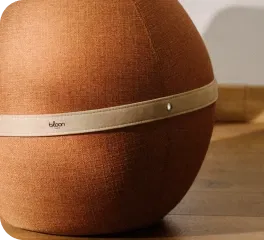
Safety is paramount during the perinatal period, which is why you shouldn't compromise on the quality of your birthing ball. Our robust Bloon birthing ball seats combine comfort and safety . They feature a weighted base and a burst-proof guarantee to ensure your stability. Their PVC air chamber is phosphate-free and therefore safe for your health.

Check the pressure of the birthing ball before each use . A birthing ball should be neither too soft nor too firm. Never inflate your ball to its maximum pressure.
Always inform the healthcare team if you are using a birthing ball so they can provide appropriate monitoring. At the beginning of labor, ask for assistance when sitting down so you can receive physical support if needed, especially during intense contractions.
If you wish to bring your own birthing ball into the delivery room, check the facility's hygiene rules. Some clinics accept outside balls provided they meet certain safety and hygiene standards.
Maintenance and hygiene of the balloon after use
Birthing balls are generally cleaned with soapy water after each use. Once rinsed and dried, they should be stored in a dry place away from sunlight and heat, which can damage the material. Similarly, avoid harsh chemicals.
Our Bloon birthing balls, suitable for pregnant women, are covered with a removable, textured, and durable fabric cover for better grip, strength, and longevity. The cover is removable and machine washable for easy care.
Properly maintaining your birthing ball helps eliminate bacteria and ensures its durability.
Conclusion
More than just an accessory, the birthing ball facilitates childbirth. By promoting movement, gravity, and freedom of movement, it helps to support labor while relieving pain .
Before, during and after childbirth , it supports pelvic mobility, improves comfort and strengthens the sense of confidence and autonomy of expectant mothers.
Used regularly and following safety advice, the birthing ball allows you to experience your birth in an active and serene way .
Our Bloon balls, guaranteeing comfort and safety, offer a stable and high-quality seat, ideal to accompany you throughout your maternity journey.